How do you choose a portable power station?
Spec sheets list dozens of numbers. A handful decide whether a station runs what you need for as long as you need it. Here's what each one means and what to look for.
We earn a commission if you buy through our links. It never changes our picks. Details
The short answer
Size from capacity first: plan on about 85% of the rated Wh being usable, so a 2,048 Wh station runs a typical fridge for about 22 to 38 hours. Then check that its continuous and surge output cover what you’ll plug in, that it uses LFP cells, and that it recharges fast enough from the wall and solar.
- 2,000+
Cycles for LFP cells, versus 1,000–2,000 for NMC.
Source: Battery University- 32°F
Lithium-ion cells should not be charged at or below freezing.
Source: Battery University- 16 ms
Minimum time a desktop power supply should ride through a gap.
Source: FSP
Not sure a portable station is the right kind of backup at all? Start with battery, standby generator or portable generator, or see the types of battery backup.
How much capacity do you need?
Capacity is the watt-hours (Wh) the battery stores. You never get all of it: the inverter that turns battery power into wall power loses some along the way. We assume 85% is usable.
Rated Wh needed ≈ daily Wh × days ÷ 0.85
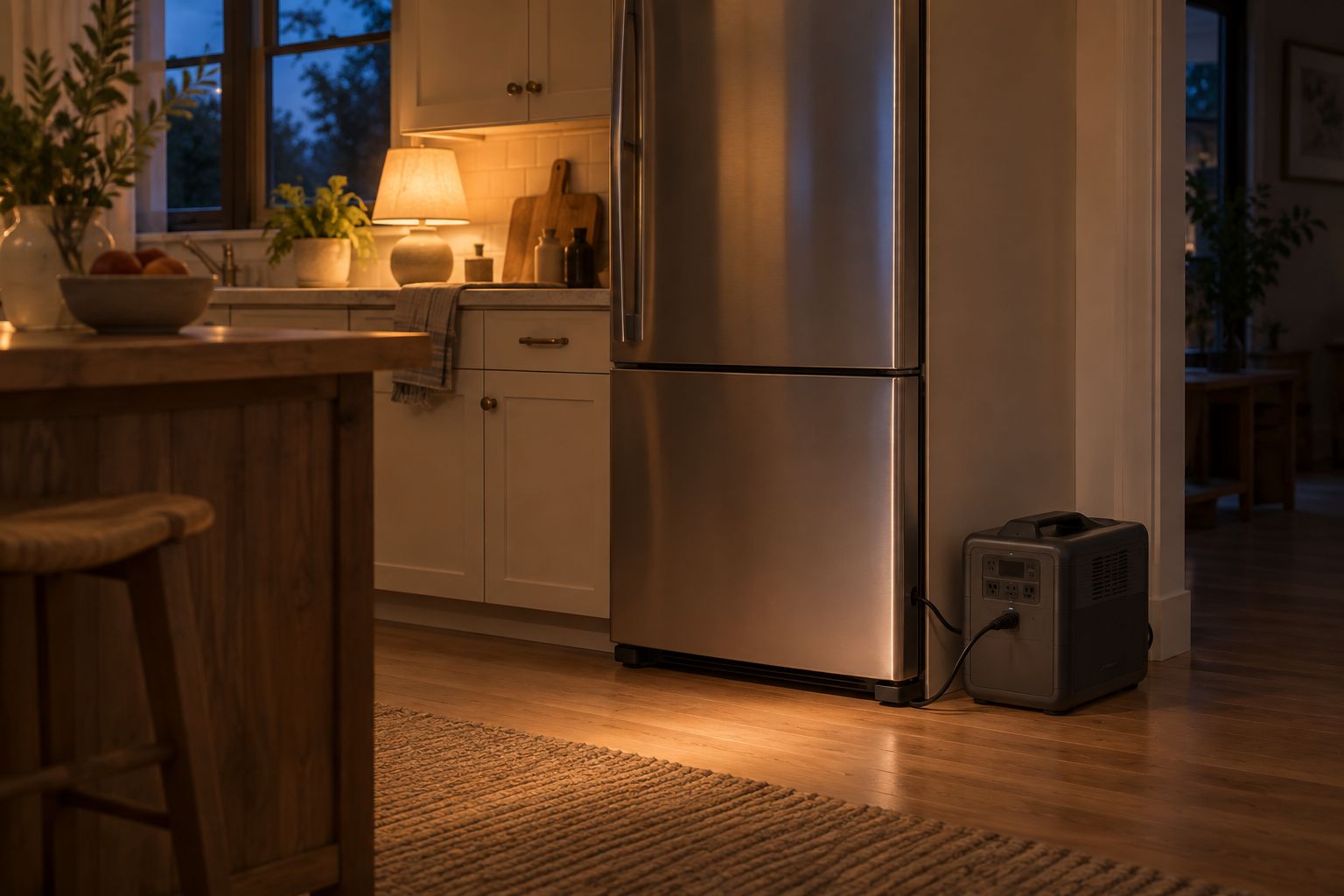
Worked example. A typical fridge uses 1.1–1.9 kWh a day (ENERGY STAR ranges). One day of fridge needs about 1,300–2,240 Wh of rated capacity. A 2,048 Wh station meets the low end but not the high end, so it runs a large fridge about 22 hours, not a full day. Three days of fridge needs about 3,880–6,710 Wh.
Our estimate using 85% of rated capacity and ENERGY STAR daily use, fridge only. How we calculate
What do continuous output and surge mean?
Continuous output is how many watts the station can supply at once, all day. Add up the running watts of everything that could be on together and stay under it.
Surge is the brief burst it can give when a motor starts. Fridges and pumps draw far more for a moment at startup. A public utility’s sizing sheet lists a refrigerator at 700 running watts plus 2,200 more to start, and a 1/2 hp sump pump at 1,050 plus 2,200 (EWEB). Your appliance’s label may say less. Check that the largest startup draw, plus everything else running, stays under the surge rating.
Which battery chemistry lasts longest?
Look for LFP, also written LiFePO₄. Battery University lists LFP at 2,000 or more cycles and NMC at 1,000–2,000. NMC is lighter for the same capacity, which matters more for a camping unit than for backup.
Read cycle ratings closely. EcoFlow rates the DELTA 2 Max at 3,000 cycles to 80% of its capacity. Jackery rates the 2000 Plus at 4,000 cycles to 70%. Those can’t be compared directly: the second counts until the battery has lost more of its capacity, so its number will always look bigger.
How fast does it recharge?
Wall. This matters most when a storm is coming. EcoFlow and Anker list 1,800 W wall inputs; Jackery lists about 2 hours for a full charge.
Solar. The max solar input caps how many panel watts count. Our solar pairing guide shows how much a panel puts back each day.
Car. It works, but slowly. Jackery lists 25 hours to fill the 2000 Plus from a 12 V car adapter. Treat it as a top-up.
Which outlets and extras matter?
Expandability. Add-on battery packs let you start smaller and add capacity later. Check the maximum before you buy.
120 V or 120/240 V. Most stations are 120 V only. A 240 V well pump or a feed to a transfer switch needs 120/240 V output. The Anker F3800 has an L14-30 and a NEMA 14-50 outlet, each rated to 6,000 W at 240 V (Anker). A TT-30 is a 120 V RV outlet. Wiring any of these into the house needs an electrician.
12 V DC outlets. A car-style 12 V outlet or DC barrel port lets a CPAP run on its DC cord and skip the inverter. See the CPAP guide.
Switchover time. In pass-through (UPS) mode, the station takes over when the grid drops, after a short gap. Jackery lists 20 ms and Anker under 20 ms. EcoFlow doesn’t list a figure on its product page. Desktop power supplies are expected to ride through a bit more than 16 ms (FSP), so a desktop may restart. A CPAP may stop too. Try it once in the daytime: unplug the station from the wall while the device runs.
What about weight, noise, cold and warranty?
- Weight and wheels
- Our two 2,000 Wh picks weigh about 50 and 61.5 lb. The 132 lb Anker F3800 has wheels and handles (Anker). Plan where it will live before you buy.
- Fan noise
- Brands rarely list it. Jackery says the 2000 Plus has a silent charging mode of up to 30 dB that takes 4.5 hours to fill it (Jackery). Expect more fan noise at full-speed charging, and keep it out of the bedroom if that bothers you.
- Cold garages
- Lithium-ion should not be charged below 32°F (Battery University). Jackery lists charging at 32–113°F. Anker lists operation at −4°F to 104°F. EcoFlow does not list a charging range on its product page. Charge indoors in winter.
Which specs can you ignore?
- “Boost” watts. EcoFlow lists 2,400 W continuous and 3,400 W in X-Boost mode (EcoFlow). Size from the continuous number.
- Device counts (“powers 15 devices”) tell you how many outlets it has, not how long it runs them.
- Lifespan in years depends on how often you cycle it. The cycle rating, and what it counts to, says more.
What should be on your checklist?
- Rated Wh × 0.85 covers your daily Wh times the days you want.
- Continuous output covers what runs together; surge covers the biggest startup.
- LFP cells, with the cycle rating’s percentage noted.
- Wall charging fast enough to fill it before a storm; solar input for long outages.
- 240 V only if you need it; a 12 V outlet if you run a CPAP.
- A switchover time listed, if a computer or CPAP stays plugged in.
- A weight you can move, and a warm place to charge.
How do our three picks compare?
| Spec | EcoFlow DELTA 2 Max | Jackery Explorer 2000 Plus | Anker SOLIX F3800 |
|---|---|---|---|
| Capacity | 2,048 Wh | 2,042 Wh | 3,840 Wh |
| Output (surge) | 2,400 W (4,800) | 3,000 W (6,000) | 6,000 W (9,000) |
| Cycles | 3,000 to 80% | 4,000 to 70% | 3,000+ to 80% |
| Max solar input | 1,000 W | 1,400 W | 2,400 W |
| Voltage | 120 V | 120 V | 120/240 V |
| Expands to | 6,144 Wh | 12 kWh | 26.88 kWh |
| Weight | About 50 lb | 61.5 lb | 132.3 lb |
| Fridge runtime | 22–38 hrs | 22–38 hrs | 41–71 hrs |
Manufacturer spec all rows except fridge runtime · Our estimate fridge runtime, fridge only, at 85% of capacity and 1.1–1.9 kWh a day. How we calculate Expansion is per unit; Anker lists 53.8 kWh for two linked F3800s.
Our picks
Specs are the manufacturer's. Runtimes are our estimate for a typical fridge only.
Best for most homes
EcoFlow DELTA 2 Max
22–38 hrs on a typical fridge Our estimate
2,048 Wh · 2,400 W (4,800 W surge) · LFP, 3,000 cycles · about 50 lb Manufacturer spec
About 2,000 Wh, LFP cells, a 12 V car outlet and two DC5521 ports, and room for two extra batteries.
Trade-off: Its 1,000 W solar input is the lowest of these picks.
Most output at this size
Jackery Explorer 2000 Plus
22–38 hrs on a typical fridge Our estimate
2,042 Wh · 3,000 W (6,000 W surge) · LiFePO₄, 4,000 cycles · 61.5 lb Manufacturer spec
The same 2,000 Wh class with 3,000 W of continuous output, 1,400 W of solar input, and expansion to 12 kWh.
Trade-off: Heavier for the same capacity, at 61.5 lb, and its 4,000-cycle rating is counted to 70%, not 80%.
The only 120/240 V pick
Anker SOLIX F3800
41–71 hrs on a typical fridge Our estimate
3,840 Wh · 6,000 W (9,000 W surge) · LFP, 3,000+ cycles · 132 lb Manufacturer spec
Nearly double the capacity, 6,000 W of output, and 240 V outlets for a well pump or a transfer switch.
Trade-off: At 132 lb on wheels, it rolls but you won't lift it.
Common questions
How many watt-hours do I need in a power station?
Add up what you'll run in a day, multiply by the days you want, and divide by 0.85 to allow for conversion losses. A typical fridge uses 1.1–1.9 kWh a day, so one day of fridge alone needs about 1,300–2,240 Wh of rated capacity.
Is LFP better than NMC for a home backup battery?
For backup, usually yes. Battery University lists LFP at 2,000 or more cycles and NMC at 1,000–2,000, though LFP is heavier for the same capacity. All three of our picks use LFP cells.
Can I charge a power station in a cold garage?
Not below freezing. Lithium-ion cells should not be charged at or below 32°F, and Jackery, for example, lists a charging range of 32–113°F for the Explorer 2000 Plus. Bring the station inside to charge, then move it back out.
Can a power station work as a UPS for my computer?
Many have a pass-through mode, but they switch over in about 20 ms, not instantly. Intel's guideline asks desktop power supplies to ride through only a bit more than 16 ms, so a desktop may restart. For a desktop that can't drop, put a dedicated UPS between it and the station.