How to keep your fridge and freezer cold through a 2–3 day outage
A closed fridge holds safe temperatures for about four hours. After that, you need power, ice, or a plan. Here's how big a battery actually has to be.
We earn a commission if you buy through our links. It never changes our picks. Details
The short answer
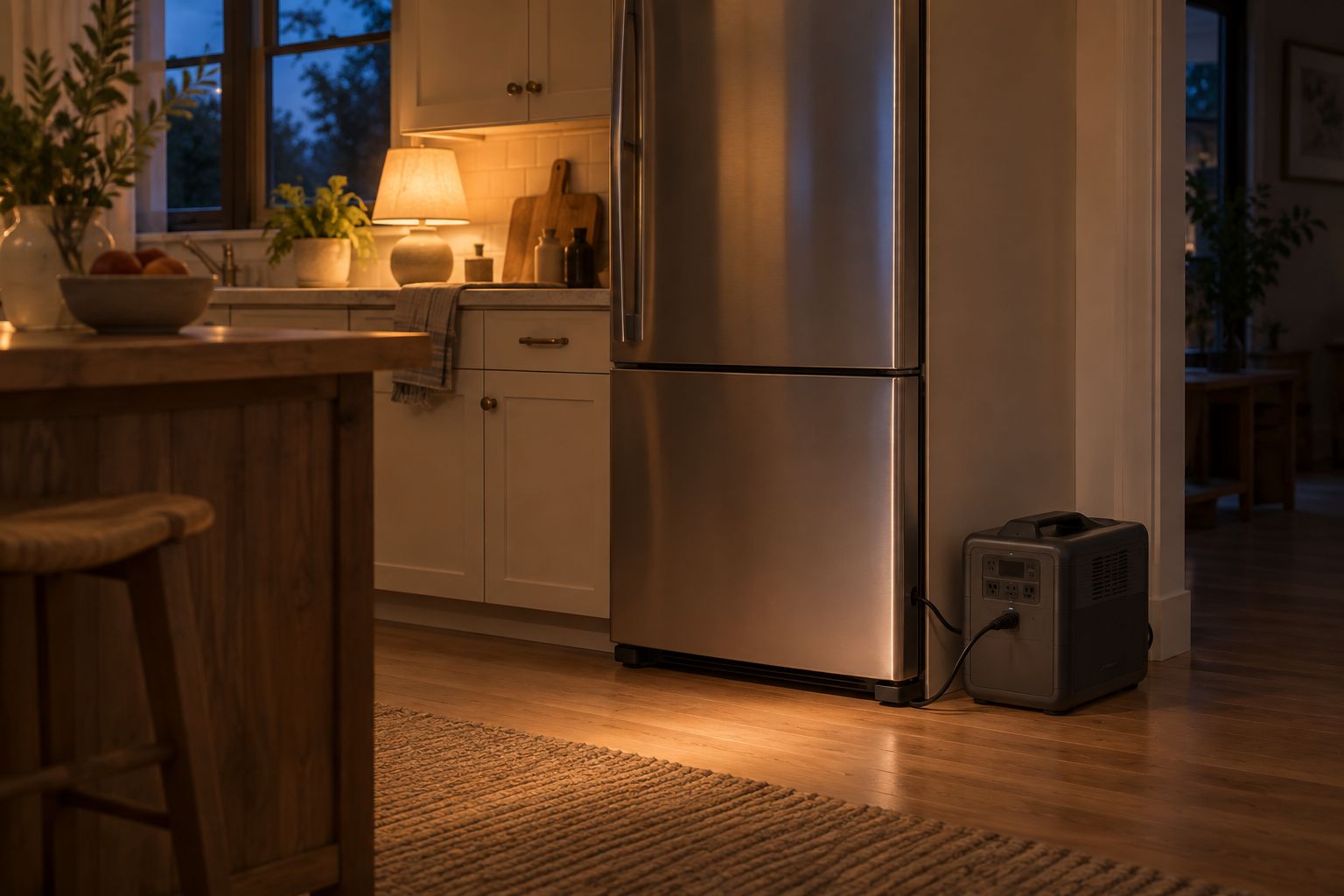
A typical modern refrigerator uses about 1.1 to 1.9 kWh a day. A 2,000 Wh power station covers that for roughly 22 to 38 hours; a 3,840 Wh unit stretches it to 41 to 71 hours, most of the way through a 2–3 day outage.
- 4 hrs
A closed fridge keeps food safe without power.
Source: USDA- 48 hrs
A full, closed freezer holds. Half full: about 24.
Source: USDA- 1.1–1.9
kWh a day for most ENERGY STAR fridges.
Source: ENERGY STAR ranges
How long each size runs a fridge
The bar shows the range from a hungry side-by-side (left end) to an efficient top-freezer model (right end).
Which size fits your outage
- Usually under a day
- A ~2,000 Wh station. Keep the doors closed and it carries the fridge overnight with room for phones and Wi-Fi.
- Two to three days
- A ~3,800 Wh unit gets you about 41–71 hours. For a sure 3 days, use a 2,000 Wh unit plus two extra batteries, or add solar.
- Fridge and a chest freezer
- Add the freezer's EnergyGuide number to the fridge's and size from the total. The runtime calculator does the math.
Three units that do the job
Specs are the manufacturer's. Runtimes are our estimate for a typical fridge only, not a fridge and a freezer.
Best for most kitchens
EcoFlow DELTA 2 Max
22–38 hrs on a typical fridge Our estimate
2,048 Wh · 2,400 W (4,800 W surge) · LFP, 3,000 cycles · about 50 lb Manufacturer spec
About a day of fridge, and takes up to two extra batteries if your outages run longer.
Trade-off: At 50 lb it stays put once it is next to the fridge.
Best if you add batteries later
Jackery Explorer 2000 Plus
22–38 hrs on a typical fridge Our estimate
2,042 Wh · 3,000 W (6,000 W surge) · LiFePO₄, 4,000 cycles · 61.5 lb Manufacturer spec
Similar runtime to the DELTA 2 Max with more output headroom, and expands to 12 kWh with add-on packs.
Trade-off: Heavier for the same capacity.
Longest fridge runtime of these picks
Anker SOLIX F3800
41–71 hrs on a typical fridge Our estimate
3,840 Wh · 6,000 W (9,000 W surge) · LFP, 3,000+ cycles · 132 lb Manufacturer spec
The longest fridge-only estimate here, 41–71 hours.
Trade-off: At 132 lb on wheels, it is closer to an appliance than a portable.
Make the battery last longer
- Keep the doors shut. Every opening lets the cold out, and the compressor has to win it back.
- Fill the freezer. A full freezer holds cold about twice as long as a half-empty one. Frozen water bottles count.
- Turn off the ice maker and door heaters if your fridge has an energy-saver switch.
- Use a thermometer. 40°F or below in the fridge and 0°F in the freezer are the lines that matter (USDA).
Common questions
Can a power station handle the fridge's startup surge?
All three units above list surge ratings of 4,800 W or more, well beyond what a household fridge draws when its compressor kicks on. The startup draw lasts only a moment, so it's the surge rating that matters here, not the continuous one.
Is it safe to run a power station indoors?
Battery stations make no exhaust, so yes, unlike gas generators. Keep them dry and give the vents room.
What if the outage runs past the battery?
Recharge from solar, a car, or a neighbor's working outlet, or start moving food to coolers with ice before the fridge passes 40°F. A thermometer in each compartment tells you when it's time.